Why Successful Men Risk Everything for an Affair
When everyone admires you, who can still tell you no?

If you haven’t already seen the news, Reuters reported that NVIDIA’s co-founder and former CEO, Jensen Huang, acknowledged being unfaithful to his wife. Not only that, but his mistress is suspected to be a secret agent for China.
Just this morning, Jensen Huang resigned as CEO of NVIDIA after a report of yet another affair. He’s no longer CEO or a member of the board. An interim CEO is taking over the company he built into one of the largest in the world. It kind of seems like, within the course of a few days, he lost everything.
This guy is one of the richest men in the world. He’s been married for over 40 years to the lady who helped him grow this successful business. Why would he risk everything for an affair?
The details of the story are all over the Internet right now, but what I’m interested in is this:
What happens when a man’s influence, his success, his authority grows? What happens inside of him that leads to this level of moral failure?
My own story
To be fair, I haven’t achieved that level of success. I’m not worth billions or trillions of dollars. But I have had a small glimpse of this.
Back when I owned my company, I was earning more money than I ever thought I would make. My wife and I didn’t really have to say “no” to much financially. If something came up that we could use or that would be helpful, we just bought it. We didn’t have to stress about it.

We still did our budget every month, so we weren’t blowing it on every little whim, but we did go a few years without really having to say no to too much.
I know that sounds like a great place to be, to have that kind of financial freedom, but I didn’t realize that it came with a cost:
Financial freedom cost me my ability to deny myself and say “no.”
I’ll speak for myself here, not for my wife: when I sold my company and later our income decreased, and we started having to say “no” to things again, self-denial was harder than I want to admit.
Even with little, insignificant things where it wasn’t a big deal to say, “No,” something in me pushed back. I felt, “I’m supposed to have that. What’s happening that I can’t have that anymore?”
It was a bigger shift for me than I would’ve expected.
When you become so used to having what you want, when you want it, I can see how eventually nothing feels off the table anymore. Everyone’s looking up to you, complimenting you, clamoring for your attention. You have plenty of resources to do whatever you want.
It’s possible to fall into this sort of God-mode mentality. Not that you’d ever call it that or even notice it, but underneath it there’s a belief that, “I can have whatever I want.”
Eventually, something you used to think you would never, ever do starts becoming the logical conclusion. Instead of “I would never do that,” you think, “Well, why wouldn’t I do that?”
This isn’t just a corporate America, CEO, thing. Pastors can have their own little world where they have influence and authority. Fathers can do this in their own homes.
Anywhere authority or control goes to our heads, we have the potential to ruin the lives of the people we’re leading.
It happens everywhere.
This story is unfortunately too common
I had AI research what this looks like in our country.
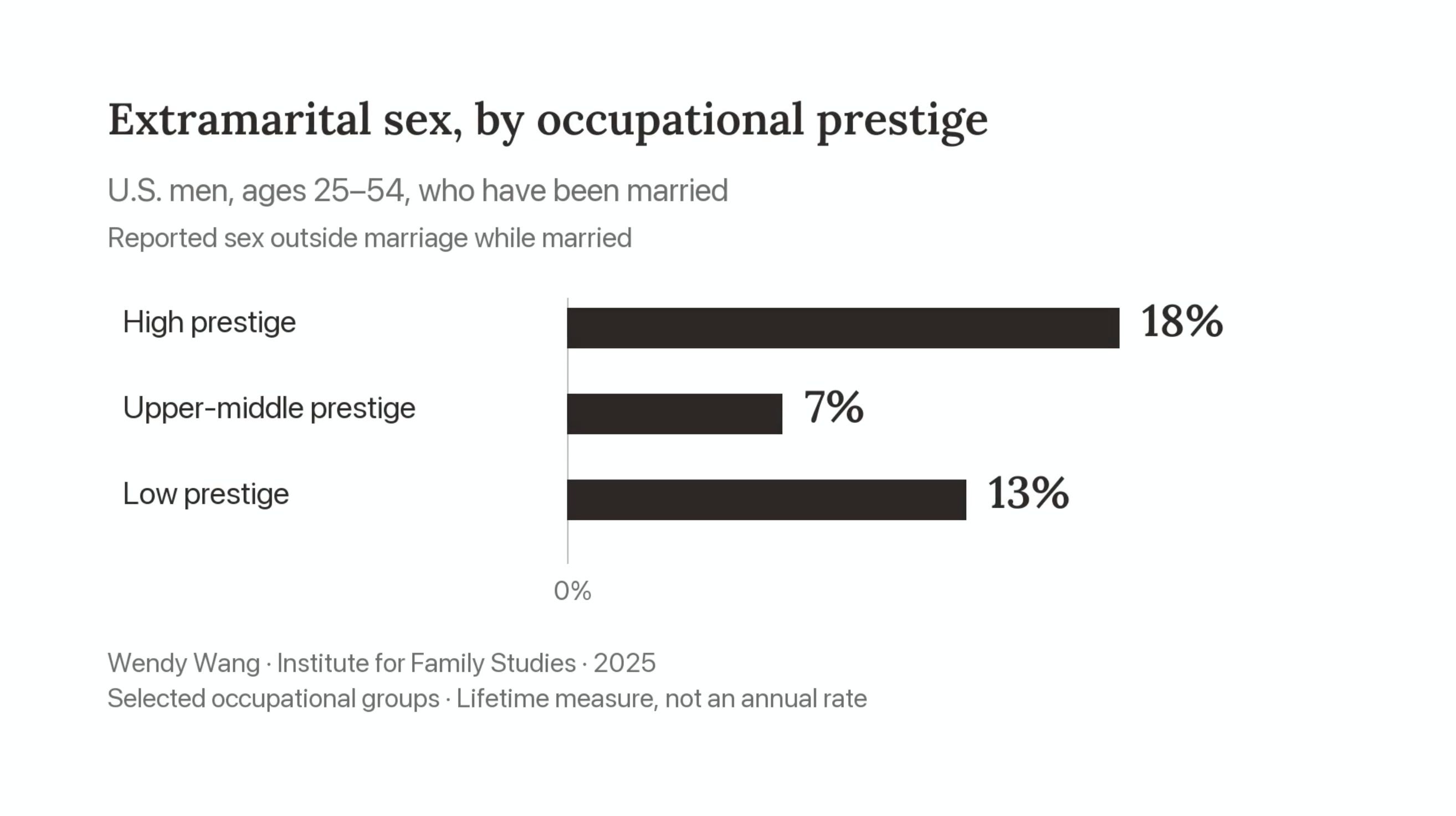
A 2025 Institute for Family Studies analysis of General Social Survey data reported that 11% of U.S. men ages 25 to 54 who have been married said they had sex with someone other than their spouse while married.
The occupational breakdown was interesting. The analysis reported lifetime extramarital sex among 18% of men in high-prestige occupations, compared with 7% in upper-middle-prestige occupations and 13% in low-prestige occupations. I imagine the numbers are much higher when you include those who don’t self-report these behaviors and include other behaviors like secret messages or emotional affairs.
A 2011 survey of 1,561 professionals also found an association between power and reported infidelity, as well as intentions to be unfaithful.
That doesn’t mean that getting promoted causes somebody to have an affair, but it does prompt me to wrestle with the question:
What happens when being wanted starts to feel like proof of your importance?
This can happen to you and me, too
We shouldn’t deceive ourselves into thinking we’re immune to this.
This whole Elder My City idea is about exploring the question, “What kind of man should we be becoming before we’re entrusted with more?” Faithfulness in the home, elders in the city, and preparing for the responsibility the King entrusts to his servants. In Luke 19, the faithful servants are given authority over cities. Cities include people, not just bank accounts and property. It’s a lot to manage well for the King.
So what does that look like for us right now?
In Titus 1:5-9 and 1 Timothy 3:1-7, Paul gives the qualifications for men who aspire to be elders: marital faithfulness, self-control, sober judgment, how a man manages his household, not arrogant, not violent, not greedy, alongside the ability to teach.
And what really irks me today is that…
It’s possible to be considered a great man even when your home is a wreck.
That idea is foreign to these qualifications.
Paul asks:
“...if someone does not know how to manage his own household, how will he care for God’s church?” (1 Timothy 3:5, ESV)
Only growing a successful business or an online audience doesn’t qualify you to actually care for people. We have to look at the whole man, starting with his household and the life he’s living there.
What do God-fearing men critically need today?
Practically speaking, we need three things.
1. Men who exhort us
I keep coming back to Hebrews 3:12-13:
“Take care, brothers, lest there be in any of you an evil, unbelieving heart, leading you to fall away from the living God. But exhort one another every day, as long as it is called ‘today,’ that none of you may be hardened by the deceitfulness of sin.”
Men, sin is deceitful. We should never be arrogant enough to think it won’t affect us. The warning is that we can develop a heart that leads us to fall away from God. That’s why we’re told to exhort one another every day.
We need some guys in our lives who will be tough with us. Not just people who admire us.
Honestly, for me, it’s a lot more “fun,” to hang out with people who are like, “Oh, Tim, you’re the YouTube guru guy!”
I mean, I’m happy to talk about YouTube. I love talking about it. No issues there. But when I’m seeking out those people because it makes me feel a certain way, something’s happening in my heart.
I need someone who doesn’t care about YouTube. Someone who can say, “Tim, I don’t care about your career. I mean, I do because I care about you, but you could do whatever. What’s happening inside of you?”
We need men who will challenge us, but unfortunately, a lot of us are too isolated for it.
Who knows your family? Who has spent enough time in your home to see what that environment is like? Who can poke at you, push at you, exhort you?
2. No secret places
Have no places where secrecy can grow. Have clear boundaries around private messaging, travel, alcohol, spending, and one-on-one settings. Be very careful about emotional intimacy popping up.
If something in your marriage is frustrating you and you start venting about it to a woman you’re attracted to, stop it! Calling it “seeking counsel” or “just helping each other” doesn’t change what’s happening. Have that conversation with a guy who’s willing to challenge you.
If travel is a struggle, make a plan beforehand. Don’t wait until you’re away from home and negotiating with yourself about how this time will be different.
For my wife and me, she has access to my phone whenever she wants. She knows my passcode. It’s always free game, anytime.
3. Practice saying “no” before there’s a crisis
If I could go back to the time when we had the financial freedom we wanted, I’d tell myself, “Tim, maybe you can buy that thing and it would be fine financially, but you shouldn’t buy it because it’s not good for your heart.”
You need to practice saying “No” and denying yourself of whatever pleasure comes to mind. Set a budget that forces you to say, “No,” to some things. The Bible is full of spiritual disciplines that involve self-denial and self-restraint, so this isn’t a new idea.
I do intermittent fasting now. In the mornings, I’m skipping breakfast and thinking, “This is hard. I want to eat.” But I know the benefits are worth the discomfort, so I continue anyway.
In the Bible, there’s fasting, confession, worship, service, repentance, and more. The point isn’t to deny yourself so you can feel like you’re a better Christian. You’re not earning anything here, you’re keeping your heart in check.
Practice self-denial and saying, “No,” so it doesn’t feel weird or odd when the big thing hits. Have that skill developed before you need it.
But if you’ve already crossed the line…
…whether that’s sexual contact, an emotionally involved relationship, embezzlement, or something else, seek help. There was a time in my life when I needed professional help, which I’ve talked about here several times already. Working with a therapist was 100% worth it.
Have the humility to talk with someone professionally trained and qualified to help you work through this, including how to confess honestly to your wife. Don’t just dump everything on her and expect her to know what to do with it. Get help walking through that conversation.
Ensure it doesn’t happen to you
For the rest of us, I don’t want our response to be, “I’ll never be that guy.” Pride is so dangerous.
Instead, we should ask:
“I never want to become that guy. What do I need to do now?”
Here’s something practical. Talk with your wife and ask her two questions:
Where do you see me becoming harder to correct?
Are we saying, “No,” enough?
Those might be two separate conversations. Maybe the same conversation. I don’t know. Either way, on your next date night, or whenever you have time to connect, pick one or both and give her room to answer freely. Listen with humility.
She’s on your side. You guys are a team. You’ve linked arms for the rest of your life. Listen to the wisdom the Lord has given her.
Comment Below
What has helped you stay open to correction?
What has helped you keep saying no?
I’d love to hear your experiences and stories in the comments. And if this is something you want to dig into more, read the comments others are leaving. I always learn from them. I’m sure you will, too.
Discussion about this video